Wells, Septic, and Rainwater: The Complete Guide to Getting Water In (and Out of) Your Cabin
Ask anyone who’s built a cabin on raw land what surprised them most about the budget, and you’ll rarely hear “the logs” or “the roof.” Those costs are visible from day one. The number that sneaks up on people is water — getting clean water into the cabin, and getting wastewater safely out of it.
Here’s the uncomfortable truth: on a remote parcel, your well and septic system can cost more than your foundation and framing combined. We’ve seen buyers fall in love with a $40,000 mountain lot, only to discover the water and wastewater bill lands somewhere between $25,000 and $50,000 before a single log is stacked.
This guide walks through every major option for cabin water and wastewater — what each one costs, when it makes sense, and the mistakes that turn a dream build into a money pit.
Start Here: What Does Your County Require?
Before you price a single option, call your county health department. In most rural counties, the health department — not the building department — controls your water and wastewater fate. They’ll tell you:
- Whether your parcel has an approved perc test (more on this below) or needs one
- Minimum setback distances between your well, septic system, property lines, and any streams or ponds
- Whether alternative systems (composting toilets, rainwater catchment, holding tanks) are legal for a full-time or part-time dwelling
This one phone call can save you thousands. Some counties won’t issue a building permit at all until an approved septic design is on file. Others allow off-grid alternatives that dramatically cut your costs. You need to know which world you’re building in.
Getting Water In: Your Four Real Options
Option 1: Drilling a Well
A private well is the gold standard for a rural cabin — reliable, permanent, and yours. It’s also the option with the widest cost range, because the biggest variable is buried underground.
What drives the cost:
Well drilling is priced per foot, typically $25 to $65 per foot depending on your region and geology. Drilling through soft soil is cheap. Drilling through granite is not. That means:
- A shallow well (100–150 feet) might run $5,000–$10,000 all-in
- A typical rural well (200–400 feet) usually lands between $10,000–$25,000
- A deep well in hard rock (500+ feet) can exceed $30,000
And drilling is only part of the bill. A complete, functioning well system also includes:
| Component | Typical Cost |
|---|---|
| Drilling (per foot, varies by depth) | $5,000–$25,000+ |
| Well pump (submersible) | $1,000–$3,000 |
| Pressure tank and controls | $500–$1,500 |
| Well casing and cap | $1,500–$3,000 |
| Trenching water line to cabin | $1,500–$5,000 |
| Water testing and treatment (if needed) | $300–$3,000 |
Before you drill: Ask neighbors what depth their wells hit water. Local drillers keep logs of nearby wells and can usually give you a realistic estimate for your area. A driller who won’t discuss typical depths nearby is a red flag.
The gamble nobody talks about: There’s no guarantee. Drillers charge by the foot whether they hit water or not. A “dry hole” happens, and you’ll pay for it. This is why local knowledge — neighbors’ well depths, county well logs — is worth more than any online estimate.
Option 2: Hauling Water + Cistern
If your cabin is a weekend retreat rather than a full-time home, a cistern system deserves a serious look. The concept is simple: a large storage tank (buried or in a utility room), filled either by a water delivery service or by hauling it yourself in a truck-bed tank.
Typical costs:
- 1,500–3,000 gallon cistern, installed: $2,000–$8,000
- Pump and pressure system: $800–$2,000
- Water delivery: $50–$150 per fill, depending on distance
For a weekend cabin used two to three times a month, a couple of thousand gallons goes a long way. Total setup often lands under $10,000 — a fraction of a deep well — and there’s zero drilling risk.
The catch: You’re never truly independent. If the delivery truck can’t reach you in mud season or a snowstorm, you’re rationing. Cisterns pair best with cabins that have decent year-round road access.
Option 3: Rainwater Catchment
Rainwater harvesting has moved from homestead novelty to legitimate primary water source, especially for smaller cabins. A metal roof, gutters, first-flush diverter, storage tanks, and a filtration system can supply most or all of a modest cabin’s needs in regions with decent rainfall.
The math: One inch of rain on 1,000 square feet of roof yields roughly 600 gallons of water. A cabin in a region getting 40 inches of annual rainfall can theoretically capture 24,000 gallons a year from a 1,000-square-foot roof — plenty for a part-time retreat and workable for careful full-time use.
Typical system cost: $3,000–$12,000 depending on storage capacity and filtration level. If you want the water potable, budget for proper filtration and UV or similar treatment on the drinking side.
Check legality first. Most states now allow or even encourage rainwater collection, but rules vary — a few states still restrict it, and some counties limit whether it can serve as a dwelling’s sole water source. This is another item for that health department phone call.
Option 4: Spring or Surface Water
If you’re lucky enough to have a reliable spring on your property, a developed spring box with gravity feed can be the cheapest water source of all — sometimes under $3,000 for the box, piping, and basic filtration. Surface water from a stream or pond is also possible with serious filtration and treatment.
The caveats are big, though: springs can slow or stop in drought years, surface water requires robust treatment to be safe, and water rights law (especially in western states) may limit what you can legally take. Treat this as a bonus option, not a plan.
Getting Water Out: Wastewater Options
Whatever comes in must go out, and this is where regulations get strict — for good reason. Failed wastewater systems contaminate groundwater, including your own well.
The Perc Test: The Most Important $300–$1,500 You’ll Spend
Before anyone designs a septic system, your soil has to pass a percolation test — a measurement of how quickly water drains through your soil. A licensed evaluator digs test holes, fills them with water, and times the drainage.
- Good perc (sandy loam): Conventional septic works. Cheapest path.
- Slow perc (heavy clay): You’ll need an engineered or alternative system. More expensive.
- Failed perc (rock, hardpan, high water table): Conventional septic is off the table entirely.
If you’re still shopping for land, make the purchase contingent on a passing perc test. A parcel that can’t perc isn’t necessarily unbuildable, but the alternatives cost real money — and that should be reflected in the land price. Plenty of “bargain” rural lots are cheap precisely because they failed perc years ago.
Conventional Septic System
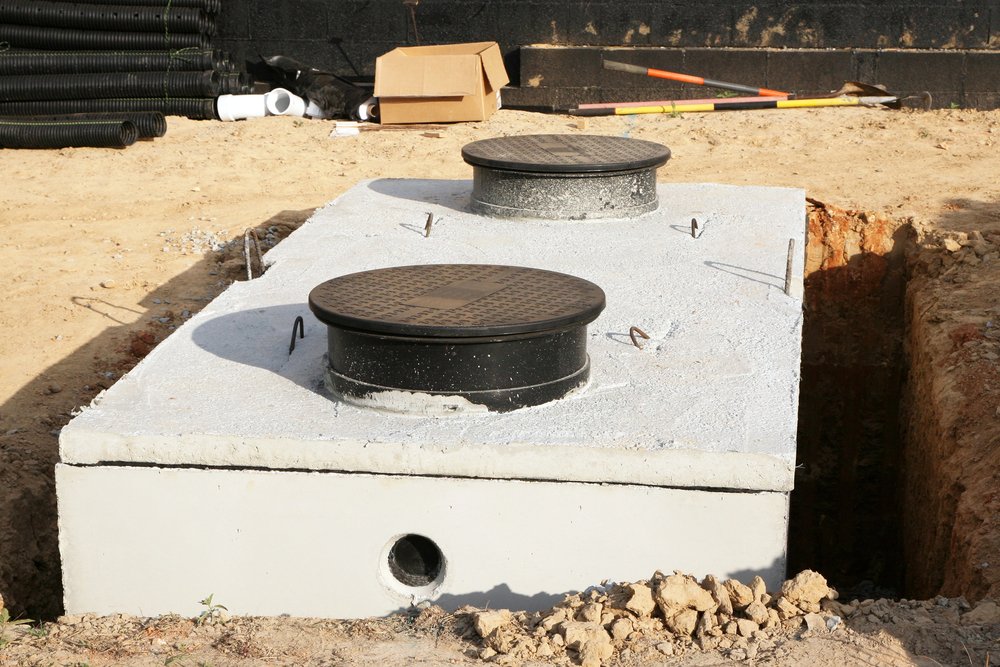
The standard setup — a septic tank plus a gravity-fed drain field — is what most rural cabins use.
Typical installed cost: $6,000–$15,000, covering the tank (usually 1,000–1,500 gallons for a small cabin), drain field piping and gravel, excavation, and permits.
Factors that push cost up: rocky excavation, long distances between cabin and drain field, and sites that require pumping uphill (add $1,500–$4,000 for a pump chamber).
Ongoing cost: Pumping the tank every 3–5 years, around $300–$600 per visit. That’s it. Conventional systems are beautifully boring when sited on good soil.
Engineered and Alternative Septic Systems
When soil won’t cooperate, engineered systems fill the gap:
- Mound systems build an elevated drain field of imported sand above the natural grade: $15,000–$30,000
- Aerobic treatment units (ATUs) actively treat wastewater with oxygen before dispersal: $12,000–$25,000, plus annual maintenance contracts in most states
- Drip dispersal systems distribute treated effluent through shallow tubing: $15,000–$30,000
These numbers are exactly why the perc test matters at the land-buying stage. The difference between good soil and bad soil is easily $15,000 or more.
Composting Toilets + Greywater
For small, off-grid, or part-time cabins, splitting the waste stream can slash costs. A quality self-contained composting toilet runs $1,000–$2,500, eliminating blackwater entirely. That leaves only greywater (sinks and shower), which some counties allow to be handled with a much smaller, simpler — and cheaper — dispersal system.
Where it’s permitted, a composting toilet plus approved greywater setup can bring total wastewater cost under $5,000. Where it’s not permitted as a primary system, you may still be required to install a septic system anyway, which defeats the savings. Again: county health department, first call.
Holding Tanks
A sealed tank that stores all wastewater until it’s pumped out. Cheap to install ($3,000–$6,000) but expensive to live with — pumping costs of $200–$400 per visit add up fast for anything beyond occasional use. Best reserved for rarely used cabins or as a temporary solution during construction, and note that some counties don’t allow them for permanent dwellings at all.
Putting It Together: Three Realistic Scenarios
Scenario 1: Weekend retreat, good road access, decent soil Cistern with delivery ($8,000) + conventional septic ($10,000) = ~$18,000. Simple, reliable, no drilling risk.
Scenario 2: Full-time cabin, typical rural parcel Drilled well at 300 feet with pump and trenching ($18,000) + conventional septic ($12,000) = ~$30,000. This is the “budget for it and don’t be surprised” number for most full-time rural builds.
Scenario 3: Off-grid small cabin, remote parcel, restrictive soil Rainwater catchment with treatment ($9,000) + composting toilet and greywater system ($4,000) = ~$13,000 — if the county allows it. If it doesn’t, add an engineered septic system and the same cabin’s water budget can triple.
The spread between these scenarios — $13,000 to $45,000+ for the same basic need — is why water and wastewater deserve a dedicated line in your build budget from day one, not a placeholder.
Five Mistakes That Cost Cabin Builders Real Money
1. Buying land without a perc test contingency. The single most expensive water mistake there is. If the soil fails, you inherit the engineered-system premium.
2. Drilling before talking to neighbors. Ten minutes of conversation about local well depths beats any regional average. Drillers’ logs of nearby wells are usually public record at the county level.
3. Undersizing the septic system to save money. A tank sized for the cabin you’re building today won’t pass inspection if you finish the loft into a bedroom later. Bedrooms — not bathrooms — drive septic sizing in most codes. If there’s any chance of adding sleeping space, size for it now.
4. Ignoring the distance between systems. Wells and septic drain fields need minimum separation — commonly 50 to 100 feet. On a small or awkwardly shaped parcel, siting one system can box in the other, and sometimes the cabin itself. Sketch all three (well, septic, structure) on your site plan before finalizing anything.
5. Skipping the water test. New well water should be tested for bacteria, nitrates, and regionally relevant contaminants (arsenic, radon, and iron are common culprits). Treatment systems range from a $300 sediment filter to a $3,000 whole-house setup — you want that number before the budget is spent.
Budgeting It Right
When you’re running numbers for your build, treat water and wastewater as their own category — separate from “utilities” — with a realistic range attached:
- Best case (good access, good soil, shallow water): $12,000–$18,000 combined
- Typical case (rural full-time build): $25,000–$35,000 combined
- Difficult site (deep well, engineered septic): $45,000–$60,000+ combined
Then do the two cheap things that narrow the range before you commit: get the perc test, and get local well-depth intel. Together they cost a few hundred dollars and remove tens of thousands of dollars of uncertainty from your project.
A cabin with reliable water and a healthy septic system is one you’ll enjoy for decades without thinking about either. A cabin without them is a very pretty shed. Plan this part first — everything else stacks on top of it.